
Written by:
AI Customer Service Is on the Hype Curve – Here’s How to Reach the Plateau Without Wrecking Trust
Michel Mertens
Managing Director

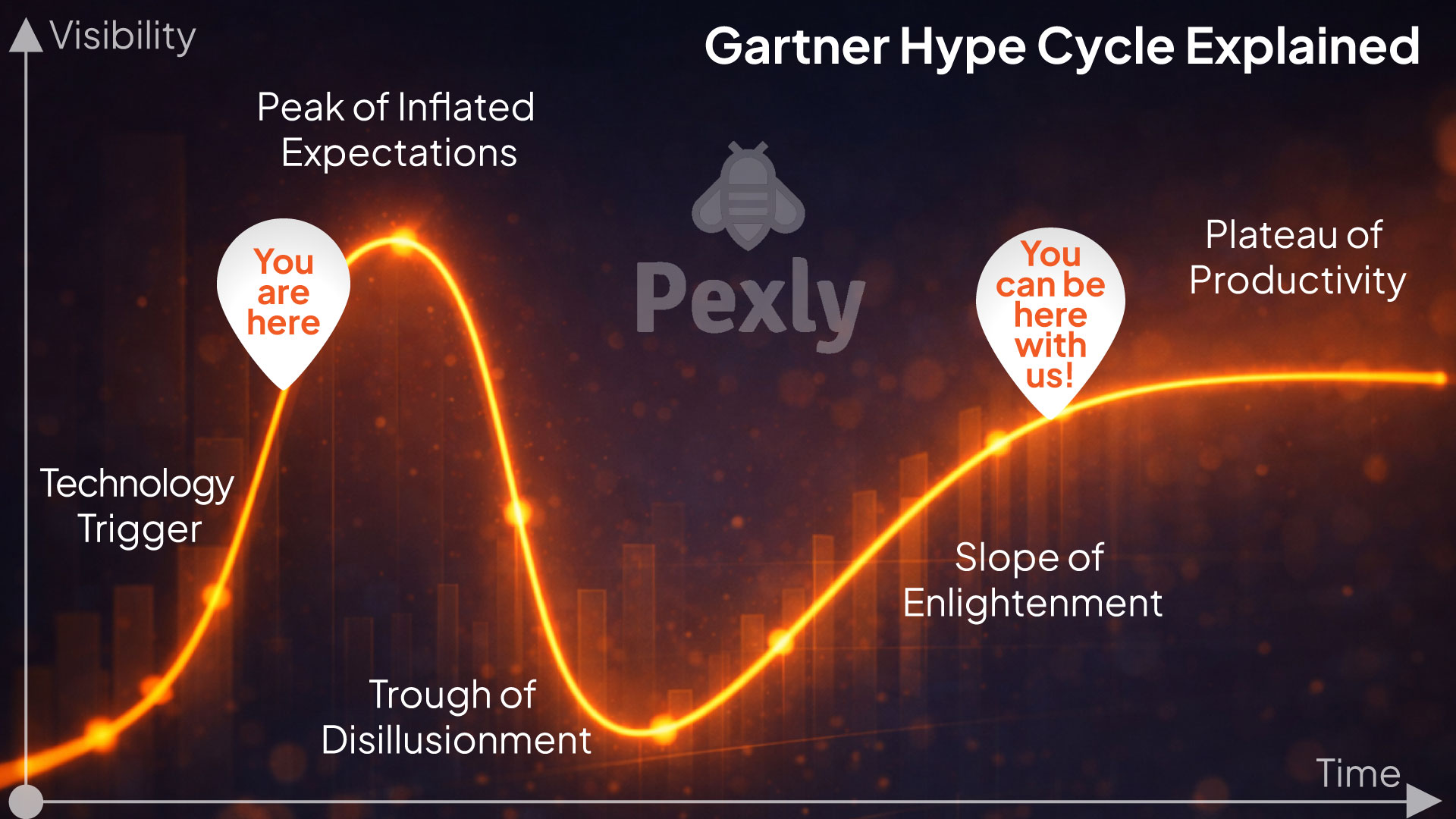
The Gartner Hype Cycle is a useful reality check for anyone adopting “the next big thing.” Gartner describes five phases most technologies pass through: Innovation Trigger → Peak of Inflated Expectations → Trough of Disillusionment → Slope of Enlightenment → Plateau of Productivity.
The point isn’t to dunk on new tech – it’s to adopt it at the right time, with the right expectations, and with a plan to turn excitement into measurable value.
Right now, conversational AI in customer service is sitting close to that “peak” for many companies. Tools are purchased, pilots launch, leadership decks fill up with time-savings… and then reality shows up: edge cases multiply, the tone becomes inconsistent, and hallucinations or policy mistakes become customer-facing incidents. This is where the hype hangover starts – and where many brands learn an expensive lesson: speed isn’t the same as a good outcome.
Klarna is the cautionary tale – because it’s so relatable
Klarna became a headline example of the “AI-first support” movement: big efficiency gains, strong internal momentum, and a public narrative that automation could replace large parts of service operations. Then the customer experience caught up. Reporting and commentary around Klarna’s support push highlights the same pattern: cost and efficiency were prioritized heavily, but service quality and customer preference for human interaction became a problem, leading Klarna to rebalance toward more human support again.
Whether you love or hate Klarna as a case study, it’s a clean illustration of the Hype Cycle in the real world: peak excitement, then the trough, then a more mature approach.
The actual question isn’t “AI or humans?”
It’s this:
Everyone is giving you fast AI — but who is giving you a responsible one?
Responsible customer support isn’t just about answering quickly. It’s about accountability: who owns the outcome when money is involved, when a customer is angry, when policy is nuanced, or when the situation needs judgment and empathy?
AI is excellent at scale and repeatability:
- instant replies for routine questions
- triage, routing, tagging, summarizing
- pulling the right knowledge quickly
That’s real productivity.
But the “plateau” doesn’t happen until you accept what AI still isn’t built for on its own:
- exceptions and edge cases
- emotionally charged situations
- policy interpretation and responsibility
- brand-sensitive communication. That’s where humans matter, not as a backup plan, but as the layer of supervision and ownership that makes automation safe.
What the Plateau of Productivity looks like in customer service
It’s not “AI everywhere.” It’s a hybrid operating model where AI and humans complement each other:
- AI handles the repetitive volume instantly (the work that should never sit in a queue).
- Humans supervise quality and step in for complex, high-stakes, or sensitive cases.
- The handoff is designed, with clear rules, QA, escalation paths, and reporting – not improvised.
That’s the difference between automation that looks good in a dashboard and automation that protects the brand.
How Pexly helps teams skip the hype hangover
At Pexly, we build human-led support operations powered by supervised AI. We use AI for speed, routing, and operational assistance – and we keep people accountable for outcomes, because real customer care still requires empathy and judgment.


